

Fuel prices are rising fast. Here’s what we’re seeing on the ground.
The fuel crisis is here. So is the shift to electric.
Over the past few weeks, fuel prices have jumped sharply across Australia.
For most people, it’s been a frustrating experience, watching prices climb overnight and wondering how high they’ll go (and if they will ever come down again).
However, this time feels a little different.
What we’re seeing isn’t just another price cycle. It’s a reminder of how exposed we are to global fuel markets, and how quickly things can change.
Why are fuel prices rising (again)?
The current spike in fuel prices is being driven by conflict in the Middle East, which is a region that plays a critical role in global oil supply.
Roughly a fifth of the world’s oil passes through the Strait of Hormuz. When that supply is disrupted, prices move quickly, and countries like Australia feel it almost immediately.
That’s because Australia imports the vast majority of its refined fuel.
So even though we’re a major energy exporter, we’re still heavily reliant on global supply chains for the petrol and diesel we use every day.
The result is something we’ve all experienced:
Prices that are volatile, unpredictable, and largely out of our control.
When fuel prices rise, it doesn’t just affect what we pay at the bowser.
It flows through to almost everything:
transport and logistics
food production and groceries
flights and travel, and
the cost of everyday goods
For households, it adds up quickly.
While the awful news cycle is hard to watch, this crisis and the conflict in the Middle East is shifting our collective thinking here in Australia.
What we’re seeing on the ground
At the local level here in Tassie, we’ve seen a huge increase in enquiries from people thinking about ditching their petrol and diesel cars and making the switch to an electric vehicle.
For many, this isn’t a new idea.
It’s something they’ve been considering for a while, weighing up costs, and whether it’s the right move and the right time.
For a lot of households, recent fuel prices have been the tipping point.
Over the last few weeks, we’ve experienced a sudden increase in demand for electric vehicle chargers, solar panels and clean energy technology.
We’re responding quickly and actively putting measures in place to scale up and make sure we can continue to support our customers, including:
scaling our team and ensuring everyone is trained up and ready to go
prioritising EV charger and solar installs over other non-urgent electrical work, and
working closely with our suppliers to ensure we have the right technology available to support our customers in this transition.
For us, more than anything, this is a clear and exciting signal.
People are ready to move when the economics make sense and there is support and trusted, reliable information available.
So what is driving this shift?
One of the most common conversations we have with customers is simply working through the numbers.
For an electric vehicle, charging at home typically costs around $3–$8 per 100km, depending on your electricity plan.
For many households, that cost drops even further when you have solar.
If you charge your car using solar power during the day, this can effectively reduce the cost per 100km to zero.
Comparatively, a typical petrol vehicle might cost around $20 per 100km to run at current prices, and as we’ve seen, that number can shift dramatically in a matter of weeks.
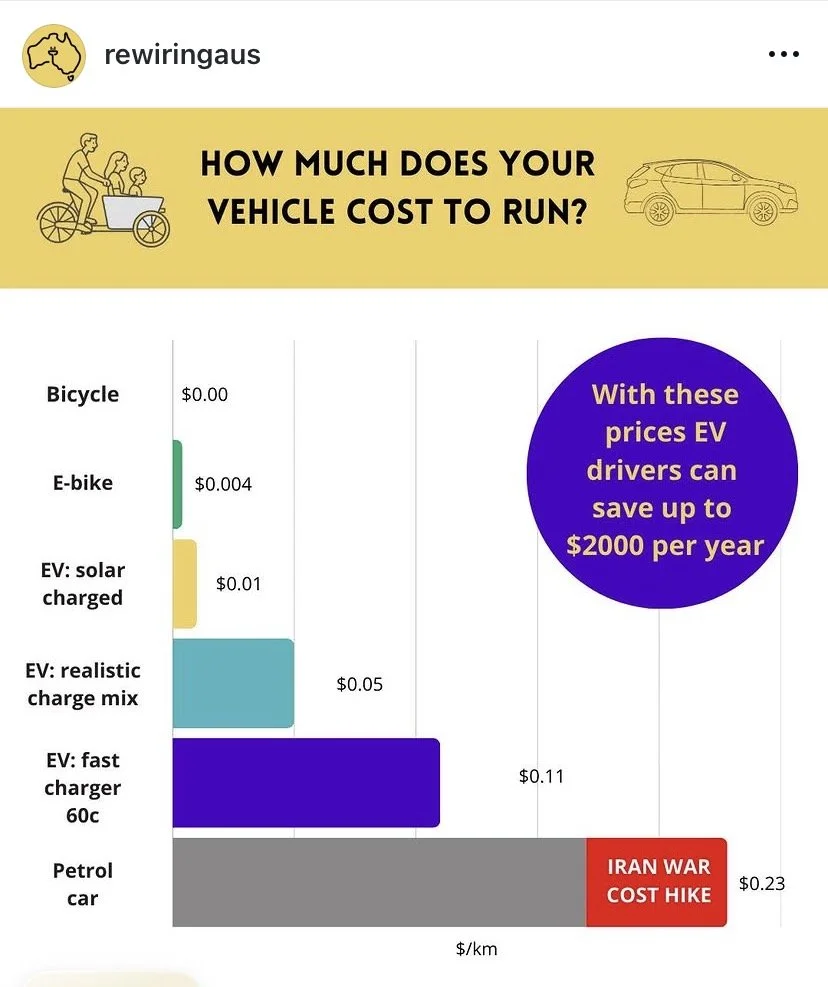
Rewiring Australia has set out the cost of charging an EV compared to using a petrol or diesel car, with the Iran war fuel cost hike factored in.
Reliance on petrol and diesel for our transport is not just expensive. It’s uncertain.
We also rely on petrol and diesel for far more than just getting from A to B.
Fuel underpins how food is grown, processed and transported across the country. From farm machinery to freight, it plays a critical role in keeping shelves stocked. As fuel becomes more expensive and less predictable, it highlights an important shift.
Electrifying everyday transport where we can helps reduce pressure on these essential systems, so fuel can be used where it’s needed most.
There is a clear alternative for everyday transport, and it is electric.
Why electrification matters
Using electric transport means we can finally cut ties to global oil markets.
What’s happening right now isn’t just about our cars.
It’s part of a much bigger shift towards electrifying the way we power our homes, transport and daily lives.
When we electrify everything, we’re no longer dependent on imported fuel.
Instead, we’re using electricity that can be generated locally (sometimes just on the roof!).
In Australia, that’s a huge opportunity.
We have some of the best solar resources in the world. And more and more households are starting to use that to power not just their homes, but their vehicles as well.
Where to from here?
Fuel price spikes like this aren’t new. But they are becoming more frequent and more unpredictable.
And each time it happens, more people start asking the same question:
Is there a better way to do this?
From what we’re seeing, the answer is increasingly yes.
The numbers stack up and people want more certainty and control over their energy costs.
Making the switch to electric doesn’t happen overnight.
But for many households, it starts with understanding the options, the costs, and what it might look like in practice.
If you’ve been thinking about it for a while, you’re not alone.
And right now, a lot of people are reaching the same conclusion:
There’s a better alternative to petrol, and it’s already here.

East coast Tassie road, much cheaper to drive in an EV!